

The New Jersey Devils are not supposed to be in a five-game tailspin. They are built around Jack Hughes, Nico Hischier, Jesper Bratt, Timo Meier, and a defense that should move the puck faster than most teams in the league. Yet recent play has raised a real question across the fan base.
Where is the extra push? Where was the urgency when the forward group clearly needed another gear?
General Manager Tom Fitzgerald has done many things right, but the lack of a decisive move at key trade deadlines has returned to the spotlight. The Devils are a young contender, not an old team clinging to a window, and that is exactly why their season feels stuck between intention and execution.
If the goal is to win now and later, then bold decisions must replace hesitation. This is one way that it could look.
The New Jersey Devils have reached a point where bold decisions are required if they want to elevate from a talented roster to a team ready to contend. This fantasy scenario presents one path built on aggressive but logical trades. The core is young, fast, and full of skill, yet the pressure on Luke Hughes, Simon Nemec, Brett Pesce, Jack Hughes, and the forward group has been heavy. The objective of this approach is simple. The Devils win more by adding a true engine on the back end, building depth scoring through youth, and staying under the salary ceiling with room to move. It begins and ends with Quinn Hughes. Jack is still out and will soon return.
To land Quinn Hughes, the price must be significant. Vancouver does not part with a franchise defender unless the return reframes their future. New Jersey offers that future.
The package is large. Dougie Hamilton, Dawson Mercer, and Seamus Casey go to Vancouver, along with first-round picks in 2026, 2027, and 2028. The first two carry top-ten protection, which protects the Devils from catastrophe in the event of a sudden collapse. Vancouver also receives immediate roster help and long-term draft control.
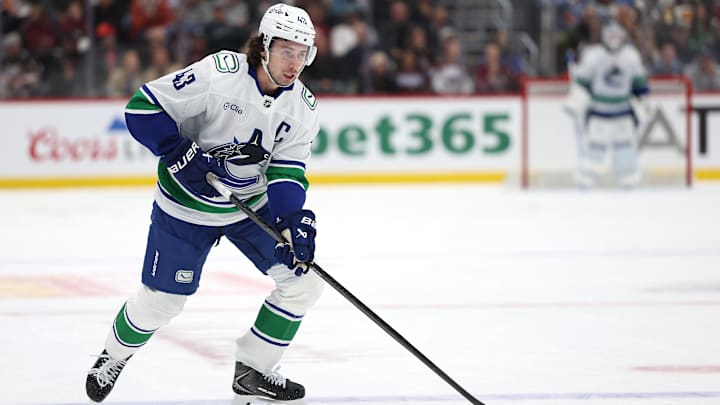
For more context, Devils fans need that puck-moving, fast-skating, super cerebral player that is the next closest player to the legendary Devil Scott Niedermayer. Devils fans are no strangers to players of this caliber, and with a leader and a Norris Trophy guy potentially in the Red and Black, this would encourage brother Luke Hughes to become more like Quinn Hughes and realize he will become a phenomenal two-way player.
Hamilton remains a top-pair defender who skates, shoots, and provides leadership. He does have a limited no-trade clause that needs to be addressed. Mercer is a high-character forward with drive, intelligence, and versatility. Casey is close to NHL-ready and can replace some puck movement on the right side. Three first round picks give Vancouver years of flexibility. They can draft, trade up, or exchange picks for roster players. It is not an easy deal to make, but it is a fair one. Dougie Hamilton has suffered from injuries in recent seasons, and has been very much above average in terms of skating speed this season. It's only a matter of parting ways for another high-end defenseman who plays the opposite style, the way Quinn Hughes does.
In return, New Jersey receives Quinn Hughes along with Danila Klimovich and Jonathan Lekkerimaki, plus a third-round and fourth-round pick in 2027. Quinn Hughes is one of the best transition defenders in the sport. He carries play with elite skating, elite exits, and a calm ability to control tempo. His upside grade is A+, and his acquisition grade is A.
He is a franchise piece who can handle heavy minutes and allow everyone around him to breathe. Luke Hughes becomes freer to jump into play. Nemec can grow without having to do everything. Pesce handles matchups and structure. Jack Hughes receives cleaner exits and more controlled entries. The effect is immediate. The ice tilts in New Jersey’s direction.
The two young forwards coming with Quinn Hughes are not window dressing. They fill a very real need in the development system. Klimovich brings a shooter mindset. His upside grade is B+, and his acquisition grade is B-. He loves to fire pucks, and he competes.
Lekkerimaki is more of a playmaker. His upside grade is A- and his acquisition grade is B. He sees seams, anticipates movement, and can grow into a top-six forward. Both benefit from time in Utica, where they will receive structure, ice, and responsibility. They could become middle-six producers for years. They are different players, but they complement each other. One shoots, one creates. Together, they give Utica and the Devils organization real depth.
The second move is smaller but purposeful. The Devils retain two million dollars of Ondrej Palat’s contract and receive Pavel Dorofeyev at $1.8 million. Palat works hard, but the fit no longer matches the age and pace of the current group. Dorofeyev brings youth, skill, and the ability to score while still being affordable. His upside grade is B+, and his acquisition grade is B. The added benefit is chemistry. He fits the timeline of Arseny Gritsyuk. These two can grow together, hunt pucks, and contribute in the middle six. The team becomes younger while staying dangerous.
The final move is a small housekeeping trade. New Jersey sends Dennis Cholowski away and receives a seventh-round pick in 2026 from Carolina, originally from Montreal. Cholowski had no clear path to NHL minutes, and the Devils hold depth on the left side in Utica. This frees a contract slot and maintains flexibility. The upside grade on the pick is C+, and the acquisition grade is B. It is not flashy, but it matters.
The Devils' recent five-game tailspin has placed a bright spotlight on General Manager Tom Fitzgerald and the decisions that were made or not made at past deadlines. When a team with this much talent suddenly looks slow and thin through the middle of the ice, the conversation turns to what could have been added. The forward core was not aggressively reinforced when the window was open and the roster needed help. The tailspin is a warning sign, and it has reshaped the urgency around the next set of decisions.
In this timeline, the Devils do not destroy their farm system or mortgage their future for a quick fix. They pay a significant price to bring in Quinn Hughes, but they do not empty the cupboards. Klimovich, Lekkerimaki, and the draft picks that come back from Vancouver keep Utica stocked and maintain development. Dorofeyev adds to the young forward group without costing a premium pick. Even the seventh rounder replaces a lost asset. New Jersey can improve without panic. They choose a solution that helps now and supports later. The core stays together. The prospect pool grows. The window is strengthened rather than sacrificed. This approach shows that a team can chase a championship without stripping its roots.
 Add us as a preferred source on Google