

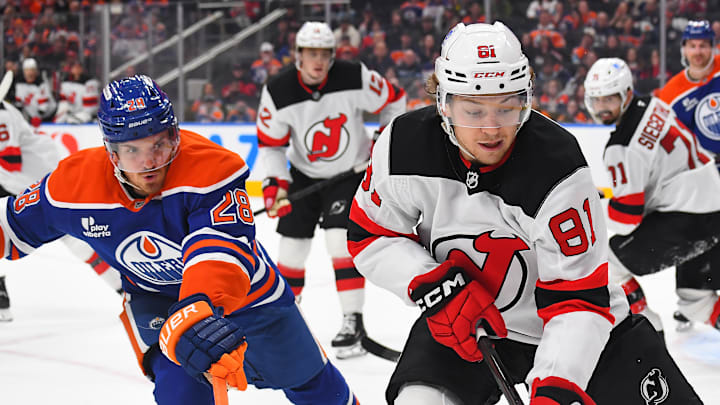
What separates Arseny Gritsyuk and Lenni Hämeenaho from typical young scorers is that neither relies on improvisation alone. Each has a defined plan for how he wins shifts, and those plans complement each other inside Sheldon Keefe’s structure.
This is why their scoring rate holds and why their upside is real.
Arseny Gritsyuk’s Plan: Speed With Deception to Break Structure
Gritsyuk’s success plan starts before he touches the puck. His objective is not to beat defenders cleanly. It is to force hesitation. Every entry, every touch, and every cut is designed to delay gap control just long enough for the structure to weaken.
He uses speed selectively. Instead of attacking straight lines, he changes pace and angle. That forces defenders to pivot twice. Once that happens, coverage breaks down. Even if no shot is taken immediately, the defense is now reacting rather than dictating.
Inside the zone, Gritsyuk’s plan is to stretch defenders laterally. His east-to-west movement pulls sticks out of lanes and opens pockets near the dots. He does not need volume shooting to score. He needs defenders to lose shape. When that happens, shot quality spikes naturally.
Defensively, his plan is just as deliberate. By pressuring exits with speed and angle rather than contact, he forces rushed clears. That keeps the puck in the offensive half of the ice and allows the Devils to re-establish possession quickly.
The result is a winger who creates offense by manipulating time and space, not by overpowering opponents. That is why his scoring scales as games accumulate and fatigue sets in.
The numbers speak for themselves.
— Daniel Amoia (@daniel_amoia) January 21, 2026
Lenni Hämeenaho’s addition to the #NJDevils lineup has injected new life into the bottom-six: https://t.co/2LbDYzWUoj pic.twitter.com/0GU028QIDp
Lenni Hämeenaho’s Plan: Control, Retention, and Repetition
Hämeenaho’s plan is the opposite in tempo but identical in purpose. His goal is to own space, not race through it.
Along the walls, Hämeenaho prioritizes body position over speed. He arrives early, sets his base, and uses stick lifts instead of lunging. That keeps his feet under him and allows him to absorb pressure without losing balance. Once possession is secured, his next move is almost always conservative in the best sense. Reset the cycle. Move the puck to support. Stay alive in the zone.
This plan produces offense through repetition. Each successful puck retention extends the shift. Each extension increases fatigue on defenders. Over time, that fatigue leads to missed assignments, lost sticks, and uncovered space near the net.
Hämeenaho’s scoring comes from those moments. He does not hunt goals. He waits for them to appear after structure breaks.
Defensively, his plan mirrors his offensive approach. Instead of chasing hits, he takes away sticks and lanes. That leads to clean recoveries rather than scramble situations. Clean recoveries turn into clean exits, which immediately support the Devils’ possession identity.
Amazing NHL debut for #NJDevils Lenni Hameenaho
— Keith (@KeithKavJr) January 20, 2026
- 12:37 TOI
- 88.9% xG Share
- 9-0 on-ice Scoring Chances
- +7 on-ice Shot Diff.
Great vision on a couple passes. Hope he sticks for a bit pic.twitter.com/ziF1x0HUuJ
Why These Plans Work Together: Gritsyuk destabilizes. Hämeenaho stabilizes.
Gritsyuk creates the initial disorder with speed and deception. Hämeenaho ensures that disorder does not reset. One breaks the structure. The other prevents it from reforming.
Together, they:
-Extend offensive zone time
-Reduce neutral zone chaos
-Protect scoring rates from volatility
This is why 18 goals is a rate, not an endpoint. Their plans do not rely on lucky bounces. They rely on actions that repeat across 82 games.
For Sheldon Keefe, this pairing is a gift. Their plans align perfectly with a possession based system. They allow controlled entries, sustained pressure, and predictable support patterns. That lets the coach roll lines, manage matchups, and protect goaltenders without abandoning offensive principles.
For the Devils, it means offense that travels. Speed with deception survives heavy games. Control with repetition survives tight games.
Gritsyuk and Hämeenaho succeed because they know how they win shifts. One bends time and space. The other owns it.
That clarity is why their scoring rate holds, why their upside is real, and why keeping them on the top wings is not optional. It is foundational.
 Add us as a preferred source on Google