

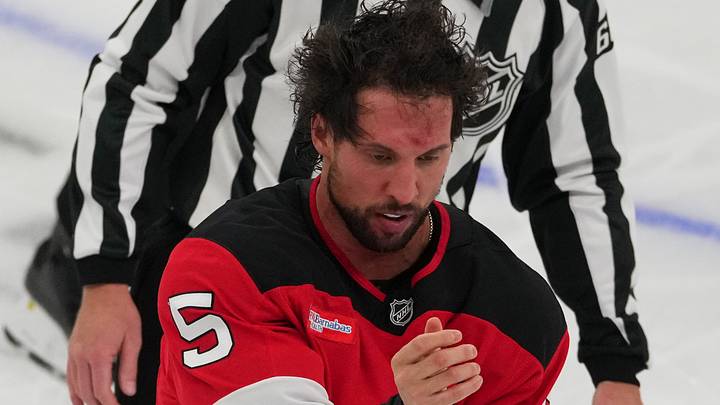
The news of the NHL suspending New Jersey Devils defenseman Brenden Dillon for four games for his hit on Denton Mateychuk raised even more concerns about the league’s lack of consistency in supplementary discipline matters.
Let’s assume for a minute that the league was right in suspending Dillon. Let’s also accept the fact that it was an illegal hit to the head, warranting a suspension.
So, why did the league only fine Montreal Canadiens forward Florian Xhekaj $2,000 for his egregious slew-foot on the Colorado Avalanche’s Fedor Svechkov?
The slew-foot incident, which happened late in the third period of the Avalanche’s win over the Canadiens on Wednesday night, drew a match penalty for Xhekaj. That situation would have prompted a two-game suspension.
It’s also worth underscoring that the league has been adamant about cracking down on slew-foot incidents.
That’s why, when looking at both incidents, the league would suspend one player and just fine the other? That’s the inconsistency that the NHL’s Department of Player Safety has long since been called out on.
And if you’re a New Jersey Devils fans, you would be right to be upset about.
Repeat offenses played a role in Brenden Dillon suspension
There is no question that prior offenses played a key role in the Brenden Dillon suspension. Dillon has been suspended once before for a similar hit in 2024, receiving a three-game ban for a hit on Noel Acciari.
All right, that seems all well and fine. It’s also that rationale that would somehow justify why Xhekaj got just the fine instead of a suspension.
This entire situation, nevertheless, harkens back to player safety. An illegal hit to the head can be just as dangerous as a slew foot. In fact, a slew foot, depending on the circumstances, can be as devastating as a knee-on-knee collision.
This situation explains why the NHL was unfair in suspending Dillon and letting Xhekaj walk. If the league isn’t going to suspend a player for a flagrant violation of the league’s safety rules, then there’s no reason why it should have issued the Brenden Dillon suspension.
In short, the NHL should have suspended Xhekaj or fined Dillon like it did the Canadiens player.
Personally, player safety is an important matter. That’s why the league should always err on the side of caution. The NHL shouldn’t use supplementary discipline as a punishment. It should use such measures as a deterrent.
In Dillon and Xhekaj’s case, it did neither. It did not punish the players, nor did it set a precedent. It just reinforced the unfair manner in which it handles player safety.
 Add us as a preferred source on Google