

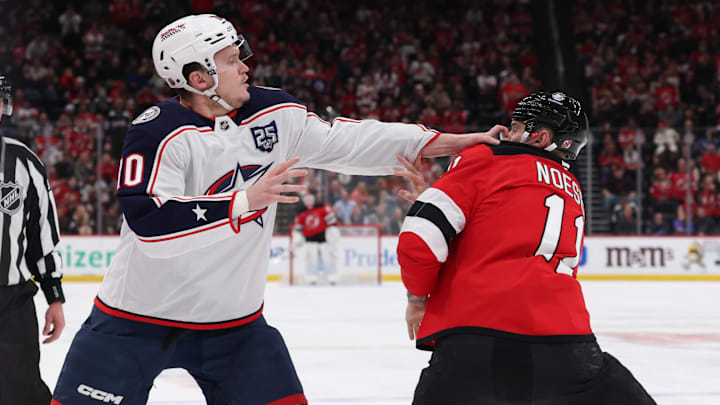
On Monday night, the New Jersey Devils and Columbus Blue Jackets had a tilt that was as exciting and ferocious as we wanted from the game. Of course, the Devils ended up losing the game 5-3, a disappointing effort from a team that really needed the win. The Devils are still in second place in the Metropolitan Division standings, but that could quickly change with how close everyone is at this point in the season.
As exciting as the matchup was, there were also factors that put the Devils in a bad spot. Obviously, the scariest moment of the night was the injury to Brenden Dillon. Dillon was celebrated by his team after celebrating his 1,000th game in the league. During a play in front of the net, he was grabbed from behind by Dmitri Voronkov.
After they got face-to-face, Dillon hit him with a soft jab to the chest with his gloves on. Apparently, Voronkov took that to mean the fight was on. He grabbed Dillon by the chest with his gloves off, shook him back and forth to get him off balance on his skates, hit him with two uppercuts and came down on his head as Dillon was falling with another right hand.
Brenden Dillon had to leave his 1000th game following this fight.
— TSN (@TSN_Sports) December 2, 2025
(🎥: MSGSN) pic.twitter.com/8ccDQ7JVeB
It doesn’t matter how you feel about the fight itself; it’s clear that this is a dangerous play. Is there intent there? Nobody except Voronov and whoever he decides to tell will ever know. However, we know it’s dangerous. We know that it doesn’t really add to the on-ice product, as this isn’t happening while the clock is moving. This is almost like a side quest of a hockey game.
And it’s a side quest that is injuring players.
Let’s take a look at the other fights happening in that game. There’s the fight between Jonas Siegenthaler and Adam Fantilli. The Blue Jackets star took his gloves off to go two-on-one with Connor Brown, who was going at it with multiple players on Columbus, to be fair. However, Siegenthaler wouldn’t have allowed his teammate to just get mugged by two guys.
More madness in Jersey: #NJDevils Jonas Siegenthaler gets ejected for not having his fight strap done after fighting Fantilli. Monahan got 2 for a high stick, Brown 2 for roughing and cross checking. #CBJ pic.twitter.com/W1XgDO9CWU
— NHL News (@PuckReportNHL) December 2, 2025
Unfortunately, Siegenthaler’s equipment got unhooked, and he had a choice: either get punched in the face multiple times while standing there, or throw some punches back and defend yourself.
Because Siegenthaler’s equipment got unhooked and the referees didn’t protect him by ending the fight when he clearly didn’t want to go, he was kicked out of the game. According to rule 46.13 of the NHL Rulebook, Siegenthaler was ejected because his jersey wasn’t connected.
"A player who engages in a fight and whose jersey is not properly “tied-down” (jersey properly fastened to pants), and who loses his jersey (completely off his torso) in that altercation, shall receive a game misconduct penalty. "NHL Rule 46.13
Fighting as it happens today is not only dangerous, but it's putting referees in an impossible position
So now, because of two fights where Devils players didn't seem ready and/or willing to fight, they were down two defensemen. And it was their only two defensive defensemen, leaving them with Luke Hughes, Dougie Hamilton, Simon Nemec, and Dennis Cholowski.
Common sense says the referees should have seen Siegenthaler's body language and the fact that he was so late to remove the gloves to know he wasn't that into the thought of the fight. He was trying to grab Fantilli, which to the naked eye could have looked like punches, but upon review, clearly wasn't. It was more of moving an aggressor away from his player.
But how is a referee supposed to know when to jump into a fight and when to let it go? They do not go on the side of caution, instead allowing fights to go on too long instead of ending them too quickly.
That brings us to today's topic. Even the one fight that looked kind of like a fight between Stefan Noesen and Voronkov was dangerous. Both players got big shots in, but Noesen was taking shots on the ground. Both players had been slammed to the ice at different points. It was a mess.
Dmitri Voronkov and Stefan Noesen now drop the mitts🤯 pic.twitter.com/XqlUU7q1zu
— Sportsnet (@Sportsnet) December 2, 2025
It's not that fighting, as it's supposed to work, is inherently a problem in the NHL. If players want to square up and have a 15-second boxing match in between whistles, then fine. The problem is the league isn't officiating it correctly. We're not looking at this from only the player protection standpoint. That's a slippery slope that eventually leads to hitting being abolished, which nobody wants.
No, we look at this more like how the NFL looks at the Tush Push. That play moves too quickly and is too crammed on the line of scrimmage to be officiated correctly. There are either false starts or offsides on basically every instance of the play. Nobody knows when the play should end and when we should count the end of forward progress. The NFL has lost control of the Tush Push, just like the NHL has lost control of fighting.
Referees are not stepping in when guys are falling on the ice. Noesen was allowed to get up multiple times this week, as he's had a busy week in the Octogon.
The NHL either needs to give referees a lesson in when they should stop fights, or they should just throw in the towel on fighting, in general. It's becoming dangerous beyond the fact of people being punched in the face. People are falling on the ice. Dillon fell face-first on the ice because he was trying to get his gloves off after the fight had already started.
Are we okay with fights happening inorganically, where there's an agreement, and the guys face off later in the game? Sure, but can we still keep those, while also removing instances like what happened with Dillon and Siegenthaler, where guys are getting punched while trying to take off their gloves? We're not convinced the NHL can manage that, which is why they need a black-and-white rule.
 Add us as a preferred source on Google