

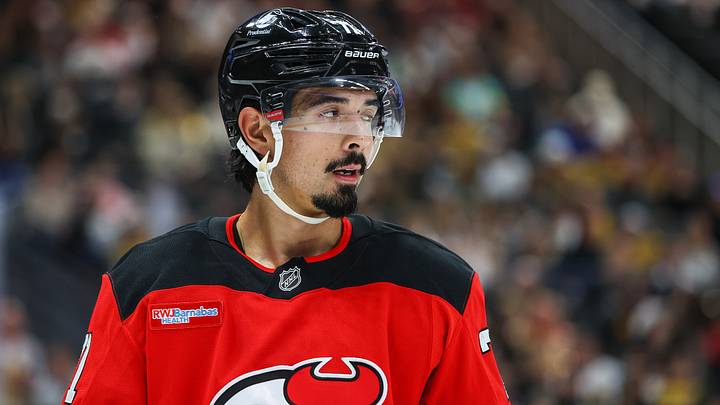
The New Jersey Devils have undeniably been an excellent team through the first 22 games of the season. They've won 15 of those games, sporting the fourth-best 5v5 expected goal share (xGF%) in the NHL to boot. They have an all-world goaltender, a mostly stalwart 5v5 defense, and an offense that can compete with the best of them.
One area that has plagued them, though, is special teams. As it currently stands, the Devils rank 22nd on the power play and 30th on the penalty kill, both far from where they should be given their talent. In recent games, it has outright cost them points—special teams was the story in their 4-2 loss to the Jets, where they went 0-for-4 on the power play while allowing two goals on four penalty-kill attempts. It was the story in their last loss, too: a 3-2 defeat at the hands of the Montreal Canadiens. New Jersey went 0-for-3 on the power play and allowed a power-play goal against as well.
Suffice to say, something needs to give if the Devils really want to establish themselves as a group that can do it all.
The good news? Positive regression is imminent, just as it was for the team as a whole through their first five games of the season, as it was for the team's finishing woes, and as it was for Timo Meier.
The thing is, both special teams units have very favorable underlying numbers, at least in public data. The smaller disparity is on the power play, where the Devils are generating the 11th-most expected goals scored per hour (xGF/60) in the league, narrowly behind the Anaheim Ducks, who have the best power-play percentage (PP%) in the league at 36.0%. It's highly unlikely that the Devils will continue to roll at a sub-20% clip much longer, especially given the talent on both units. A recent change to add a one-time threat on the flank (Arseny Gritsyuk) should boost the group, especially considering they have the sixth-worst shooting percentage on the power play at this point in time.
The penalty kill has a huge gap between expected and actual results, with the Devils' PK allowing the fifth-fewest expected goals against per hour (xGA/60). New Jersey is far and away the least-penalized team in the league, which has its merits but has largely resulted in the penalty killers being unable to find a groove for the most part. It certainly doesn't help that the Devils have the third-worst save percentage (SV%) on the penalty kill, with their goaltenders combining to save just 77% of the shots they face at that strength. That too won't last -- Jake Allen and Connor Hellebuyck are just too good for that to continue long-term.
With that, patience is a virtue. Results almost always follow underlying processes over the course of the season, and expecting the Devils' special teams to normalize over the next few months is reasonable. With the 5v5 numbers being what they are, the Devils can certainly cement themselves as a true wagon with a bit of their poor special-teams puck luck subsiding.
 Add us as a preferred source on Google