

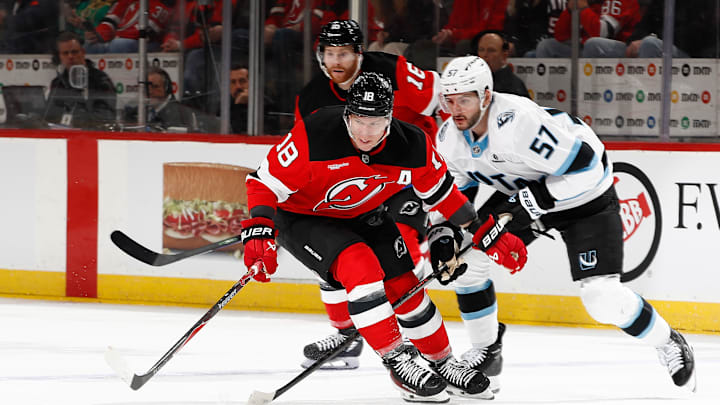
A 9-0 loss is rarely a fluke. In fact, it's often a flashing warning sign. For the New Jersey Devils, that kind of blowout should trigger a clear‑eyed reassessment of who legitimately belongs in the franchise’s long‑term picture.
The organization does have a truly exciting nucleus, Jack Hughes, Nico Hischier, and Jesper Bratt up front, Luke Hughes and Simon Nemec on the back end, with Dawson Mercer rounding out the young NHL core. That’s the group the team must protect and build around. Continuing to prop up veteran contracts that don’t fit that identity will only squander the primes of the players who define the window of contention.
Let’s be blunt: Jacob Markström cannot be the foundation in net if he’s capable of performances like the one that produced nine goals against. Goaltending is different from other positions. A reliable goalie stabilizes a team, cushions young defensemen while they learn, and preserves confidence across the roster. When your starter is inconsistent, injured, or visibly declining, it doesn’t just cost you games; it erodes the environment young players need to develop.
A single 9‑0 game is an extreme example, but it crystallizes the larger problem: the Devils can’t build toward speed and skill when they’re anchored by an unreliable, expensive veteran in goal.
Performance is the most immediate concern. Allowing nine goals in one outing isn’t an outlier you want logged on the record of your goaltender of the future. Beyond the box score, there are real consequences: Markström’s contract, not only two years and $6 million AAV, but it limits the team’s flexibility to address roster weaknesses, sign complementary pieces, or reward and retain the young core.
The salary‑cap reality is unforgiving; keeping cap space tied up in a player who isn’t delivering is a self‑inflicted handicap.
Jacob Markstrom vs #Isles:
— NHL News (@PuckReportNHL) January 7, 2026
24 shots against
9 goals against (all even strength)
-7.57 GSAx#NJDevils
There’s also a cultural cost. Young players need to feel the team is moving in a coherent direction. When management signals a commitment to a speed‑and‑skill identity, every roster decision should reinforce that. Dougie Hamilton, Ondřej Palát, and Markström are legacy veterans who, for different reasons, no longer fit neatly into that vision. Hamilton’s post‑injury limitations and price tag make him an ill fit for a blue line that must prioritize mobility; Palát’s leadership value is overshadowed by declining footspeed and bottom‑six production; and Markström’s inconsistency undermines the defensive foundation necessary for a fast, transition‑oriented game.
What should the front office do? First, move Hamilton while his name still carries value. Despite recent struggles, his pedigree and minutes could fetch a return from contenders seeking veteran defense depth, ideally a mix of a young NHL‑ready player and draft capital that aligns with the club’s timeline.
Second, explore trading Palát to free cap space and forward minutes for emerging pieces. Third, act decisively on Markström: if there’s a market, monetize his remaining value; if not, pivot quickly to younger options through trade, free agency, or internal promotion. The goal isn’t a teardown; it’s a realignment that centers the roster on the players who will define the franchise.
With the cap room and roster spots cleared, the Devils should target players who fit the team’s stylistic direction: mobile defensemen, high‑IQ role forwards who can skate and forecheck, and a goaltender whose style and workload profile align with a developing defensive corps. Acquiring a younger or more consistent netminder, whether via trade, affordable free agency, or promoting a prospect, would stabilize the team and give Jack and Luke Hughes, Hischier, and Bratt the confidence they need to drive results.
Investments should also be made in development resources and coaching that emphasize speed, puck movement and transitional play. Draft strategy must continue to prioritize skill and mobility so the core is surrounded by complementary talent, not veterans who slow the system down. Every move should be measured against one question: Does it make the team faster, more adaptable, and more supportive of the young nucleus?
A 9‑0 loss is painful, but it can also be clarifying. If the Devils treat it as a catalyst to remove mismatches and protect their young nucleus, they’ll convert frustration into forward motion. Clear the logjam of veterans who don’t fit, prioritize a goaltending solution that stabilizes rather than destabilizes, and commit fully to the identity that Jack Hughes, Nico Hischier, Jesper Bratt, and the Hughes–Nemec defensive pairing can build around. That’s how you preserve a window of contention, not by pretending a broken long‑term solution is acceptable, but by making the hard moves now so the core can flourish.
 Add us as a preferred source on Google