

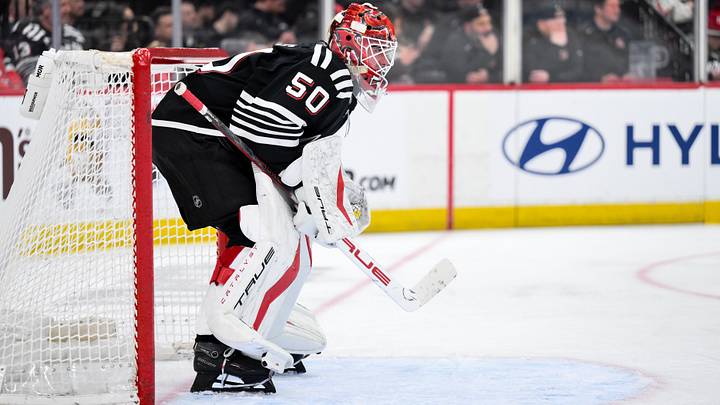
In the past few seasons, goaltender interference calls have seemingly been on the rise. But not without controversy. The New Jersey Devils have seen themselves on the opposing side of a goaltender interference challenge many times, and with that has come a lot of discussion about how, if at all, the NHL can fix the inconsistent calls.
Early in 2026, the Devils had a go-ahead goal overturned due to a confusing goaltender interference call against the Winnipeg Jets. The call very quickly became controversial.
The go-ahead goal by Jonas Siegenthaler was called back. Did the officials make the right call? 🤔 pic.twitter.com/XNNIjruIu9
— TSN (@TSN_Sports) January 11, 2026
The NHL's official rules for 2025-26 state that a goal should be overturned due to goaltender interference if one of two things happens. This occurs if an offensive player "impairs the goalkeeper’s ability to move freely within his crease or defend his goal," either intentionally or not, or if an offensive player intentionally comes in contact with the goaltender inside or outside of the blue paint.
However, the rules also state that if an attacking player is pushed into the goaltender by a defending player, it negates the interference. The rules also state that the attacking player's positioning alone should not be the basis of a goaltender interference call, and that goals scored when players are in the crease can be legal goals. It further discusses the overall aim of the rule, which is to make sure that the goaltender can move freely in his crease without being impeded by attacking players.
In this instance, it seems fairly clear that Paul Cotter was pushed into Connor Hellebuyck. He's essentially sandwiched in between Hellebuyck and defenseman Dylan Samberg, causing him to fall to the ice. Additionally, Hellebuyck follows the play outside of the crease, where the contact was made. It wasn't close either, as replays showed a near foot of distance between Hellebuyck and the blue paint.
There still isn't clarity in the goalie interference rule
The on-ice call was a goal, which was challenged by the Jets. After review, the call on the ice was overturned, bringing the game back to a tie.
There is an argument to be made that the contact outside of the blue paint further pulled Hellebuyck from his crease, which is most likely what the referees decided. They likely heavily leaned on the wording that explains the overall aim of the rule. The specific wording is important here, as the rules state, "If an attacking player enters the goal crease and, by his actions, impairs the goalkeeper’s
ability to defend his goal," and a goal is scored, the goal should be overturned. It is hard to see, but Cotter very briefly enters the blue paint prior to the contact, which is likely to have been taken into consideration when reviewing the call.
The rules also state that an attacking player pushed into the goaltender by a defenseman must make a "reasonable effort" to avoid the contact. This likely also came into consideration for this specific call, though an argument can be made that Cotter couldn't have done anything to avoid the contact.
How can this be fixed?
Revisions are needed to the rule to help standardize the calls. The wording of the rule seems to contradict itself. It states that a player's position alone cannot constitute an interference call and specifically notes that goals scored from inside the crease can be legal. It then discusses the two instances in which a goal should be overturned, one of which depends on player positioning. The NHL must be clearer on this, with better wording to explain that legal goals in the crease can be scored.
It also must be clearer on what counts as contact initiated by the defenseman and what can be classified as a "reasonable effort" to avoid the contact, as this is likely what causes the most inconsistencies between goaltender interference calls.
Would it be considered goaltender interference if an attacking player was guided into the crease by a defenseman and then made contact with the goalkeeper? Would it be goaltender interference if a player crosses into the crease, leaves the crease, and then makes contact with the goalie?
Using the rulebook, the NHL should be able to address this, but we have seen time and time again that the referees make inconsistent calls. Even the NHL's video rulebook says it is often left to the referees' discretion, which has proved to be an inconsistent way of determining whether or not goaltender interference should be called.
Whether or not you think the rulebook is clear, it's evident that referees struggle to keep calls consistent between games. Something needs to be changed, and the most obvious place to start is square one.
 Add us as a preferred source on Google