

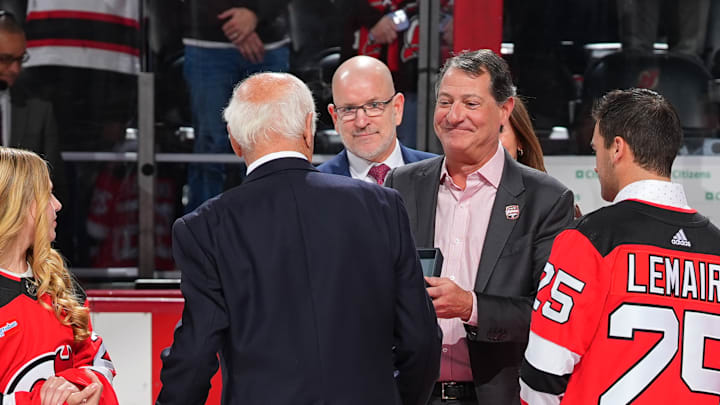
From Section 20, the message inside Prudential Center was subtle, but increasingly difficult to ignore. David Blitzer, one of the New Jersey Devils’ co-owners, was seated at ice level rather than insulated in a suite, watching the game unfold in real time. Nearby sat Jake Reynolds, the President of the New Jersey Devils and Prudential Center. This was not ceremonial. It felt evaluative.
Ice-level presence strips away abstraction. From that vantage point, ownership does not just see goals and saves. It assesses deployment, spacing, hesitation, and whether the structure empowers or suppresses instinct. Losses like a 3–0 defeat to Columbus are not dismissed as anomalies. They become data points, collected firsthand rather than filtered through postgame explanations.
When ownership begins watching the way a general manager looks for patterns rather than excuses, the conversation shifts. At that point, evaluation is no longer operational. It becomes strategic.
Losses like a 3–0 defeat to the Columbus Blue Jackets are not anomalies to ownership. They are data points. They are witnessed firsthand, not filtered through postgame explanations or analytical summaries. And when those data points accumulate, they create organizational pressure. Not emotional pressure. Strategic pressure.
What unfolded on the ice reinforced that this was not a night defined by bad luck. The Devils struggled to generate interior offense, rarely forced rebound chaos, and too often allowed defensive structure to neutralize speed. Possessions stalled along the boards. Shots came late or not at all. The problem was not effort. It was translation.
That distinction matters upstairs.
This roster is no longer framed as a developmental project. It is expected to compete. When execution consistently falls short of talent, evaluation naturally widens beyond players and toward system, usage, and leadership alignment. That is the moment when ownership attention sharpens.
The offensive identity under Jeremy Colliton has become increasingly rigid and low-yielding. At its core, the structure leans toward a perimeter and bumper-based approach, with puck movement funneled through the half-walls and high slot. In theory, that design prioritizes control and efficiency. In practice, it has produced limited returns. Too many possessions stall on the outside. Too many sequences rely on perfect execution. Too few shots generate rebounds, traffic, or second chances. The offense often looks organized without ever feeling threatening.
This is not about nostalgia. The Devils were right to evolve beyond previous iterations. But it is fair to note that under Mark Recchi, the offense took a step forward in decisiveness. Quicker decisions, higher shot volume, and a willingness to attack space created pressure even when execution was imperfect. That approach better matched a roster built on speed and instinct rather than precision cycling.
Under Colliton, the pendulum has swung too far the other way. The Devils now overprocess possessions, searching for ideal looks instead of capitalizing on available ones. Against compact defensive teams, that approach has proven easy to neutralize. When evolution results in fewer chances and less pressure, it deserves scrutiny.
That scrutiny intensified following recent postgame remarks from Sheldon Keefe, who framed the struggles as a player-execution issue rather than a system issue, emphasizing that players need to step up. In isolation, that explanation is understandable. In context, it lands poorly. When the same issues persist across line combinations, opponents, and game states, responsibility inevitably extends beyond effort alone.
That view has also been echoed externally. In recent coverage, Ryan Novozinsky pointed more toward coaching and system limitations than isolated player shortcomings. When independent observers identify the same structural problems ownership is witnessing from ice level, alignment questions become harder to dismiss.
Ownership tends to recognize patterns quickly. Explanations matter less than outcomes. And when accountability consistently flows downward rather than inward, evaluation accelerates rather than subsides.
The timing only sharpens the stakes. With the Olympic Ice Hockey Tournament approaching, the NHL schedule introduces a natural pause that invites reflection rather than momentum. Compounding matters is the absence of Jack Hughes, who will be competing in Italy. Losing Hughes does not just remove elite production. It removes the engine that often masks systemic inefficiencies. Without him, the margin for error disappears, and flaws become more visible.
There is also a practical reality to consider. If the season continues to drift, adding a high draft pick, particularly at center, becomes more than a consolation prize. It becomes an opportunity to reinforce the spine of the roster. But that addition must come with a constraint the Devils can no longer afford to treat as secondary: durability. Availability is not a bonus. It is a requirement.
A premium asset only matters if it fits a clear organizational plan. Talent, durability, coaching philosophy, and leadership alignment must move in the same direction. Otherwise, even the right addition risks being absorbed into the same cycle.
Ownership did not need a spreadsheet to see this night clearly. It was visible from the glass.
Ownership is watching closely. The window will not wait.
 Add us as a preferred source on Google