

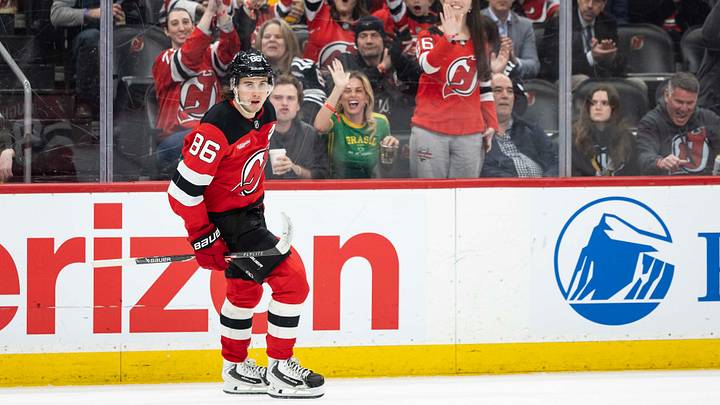
For years now, fans and prominent names in hockey have cited Jack Hughes' faceoff-taking ability as a real knock within his game and as a means to discredit his ability on the ice. It's a logical thought -- through 429 games and almost 3300 draws, he has performed spectacularly to a 35.9% clip. Among active centers with at least 3000 faceoffs taken, this ranks dead last. Not ideal, even if he is an all-world talent in terms of actually playing the sport.
The great news? It doesn’t really matter, statistically speaking.
I developed a model that used the nearly 371,000 faceoffs taken in the last five seasons to determine the value of winning one has on the next 20 seconds of continuous play. The findings should come as no surprise to those in tune with the disagreements analytics and the eye-test have about this facet of the game: faceoffs matter somewhat, but only in very specific situations.
Jack Hughes is bad at faceoffs. It doesn't matter.
At 5v5, in the neutral zone, a center would have to win 192 more draws than he loses to gain a singular goal differential. In the endzones at that strength, he would have to win 63 more draws than he loses for the same one-goal differential. It stands to reason that losing that same differential has the opposite effect.
The vast majority of value from winning draws comes from key situations: 6v5, 3v3, and the power play.
For Jack Hughes in particular, this is particularly useful to think about. He will almost never take a draw in any of those specialty situations, barring some miraculous transformation into a plus in the dot. Perhaps he will take a 3v3 draw every now and then, but remember that we used to see centers take the opening draw only to hop off for No. 86 seconds later. 6v5 and power-play draws when he is on the ice will almost certainly be taken by Nico Hischier.
NHL faceoffs and their values have been debated for, well, eternity. Some think they're what makes a center valuable, and some think they're completely immaterial.
— JP Gambatese (@jp_gambatese) September 30, 2026
So I tracked five seasons and 371,000 draws to work out what winning one is actually worth:https://t.co/JpazQSquCy pic.twitter.com/BwMk03Rdio
The bulk of faceoffs Jack takes — and likely loses — are going to be at the 5v5 stage where the results more or less simply do not matter. Is the kickstart in possession nice? Absolutely, but keep in mind that a player of his ilk gets the puck back from a loss on short notice anyway.
For those still concerned by Jack’s draw-taking abilities, remember this the next time you scoff at a faceoff loss, and focus on everything else he does at an incredibly high level instead.
 Add us as a preferred source on Google