

Following the New Jersey Devils’ breakthrough 2023 Stanley Cup Playoff victory over the New York Rangers in seven games, the organization appeared to be entering a new era. After years of rebuilding, the Devils had finally taken a meaningful step forward.
Ownership, led by David Blitzer, rewarded Tom Fitzgerald for that progress by expanding his role. Fitzgerald was elevated to President of Hockey Operations while continuing to serve as General Manager.
At the time, the decision felt justified. Fitzgerald had guided the Devils through a difficult rebuilding period and assembled a young core built around Jack Hughes, Nico Hischier, and Jesper Bratt. The expectation was that the organization would now transition from rebuilding to consistently competing.
Three seasons later, that transition has not happened as smoothly as expected.
The Devils still possess elite talent at the top of the roster, but the supporting cast has not been constructed effectively enough to maximize that core. The team has struggled to consistently add players who complement Jack Hughes’ dynamic playmaking or stabilize Timo Meier’s streaky scoring.
Last season highlighted these concerns. There was little meaningful effort to improve the bottom six forward group, and the Devils did not add enough offensive support on the wings in the top six. When a team relies too heavily on a small group of star players to generate offense, it becomes easier for opposing teams to contain that production.
This team simply cannot be shut out this many times over the past two seasons.
For a roster that features players such as Hughes, Hischier, Bratt, and Meier, repeated offensive droughts raise serious questions about roster construction. When a team with this level of talent struggles to score consistently, the issue extends beyond execution on the ice.
There have been some encouraging developments. Arseny Gritsyuk has adapted well to his first season and has shown flashes of the offensive creativity that made him an intriguing addition. Lenni Hameenaho has also demonstrated strong two-way awareness since being called up, suggesting he could develop into a reliable depth option.
However, internal development alone cannot address every weakness on a roster that is expected to compete for a playoff position. The larger concern may lie in the structure of the Devils’ front office.
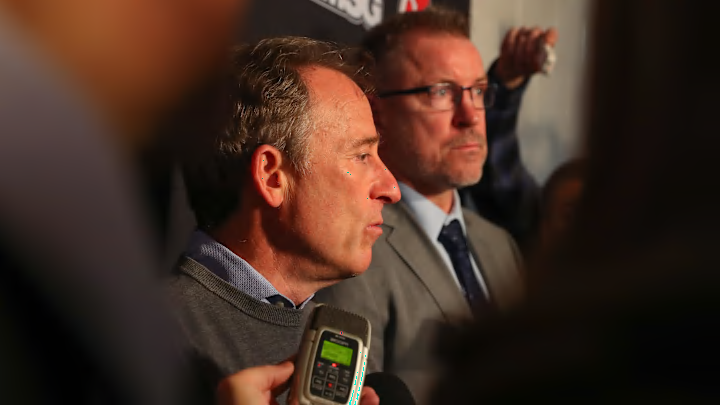
Tom Fitzgerald currently serves as both President of Hockey Operations and General Manager. In today’s NHL, many organizations separate those responsibilities in order to create stronger internal oversight. When one individual holds both positions, accountability can become limited. It defies the rules of The Art of War, where communication and execution from the chain of command have failed to execute the logistics of strategic planning.
If Fitzgerald were serving strictly as General Manager, he would report to a President of Hockey Operations who could evaluate the organization’s roster decisions and long-term direction. That structure allows for greater strategic balance and often prevents stagnation within a front office.
Without that layer of oversight, the Devils are operating within a system where Fitzgerald’s decisions face limited internal challenge.
Recent rumors have added another layer to the discussion. Defenseman Simon Nemec has reportedly been mentioned in potential trade discussions involving Toronto forward Matthew Knies. The Devils reportedly explored the possibility of moving Nemec following a change in representation, with the goal of acquiring a premium scoring forward for the top six.
If accurate, that type of move would represent a significant organizational decision.
Nemec remains one of the most talented young defensemen in the Devils’ system, and trading him could shape the future of the roster for years to come. Decisions of that magnitude should ideally be made within a structure that includes strong oversight and long-term strategic evaluation.
At the same time, it has been suggested that Fitzgerald maintains a close working relationship with David Blitzer. While trust between ownership and management is important, a relationship that is too closely aligned can sometimes reduce the level of internal scrutiny that large organizations require.
None of this diminishes the work Fitzgerald did during the rebuilding process. He deserves credit for guiding the Devils through a difficult transition and assembling a talented young core that still has considerable potential.
Tom Fitzgerald has not done enough for the New Jersey Devils
However, building a competitive roster and sustaining long-term success requires different stages of leadership.
The Devils now face several roster decisions involving veteran players that could shape the next phase of the organization. The acquisition and contract situation involving Jacob Markstrom is one example. Waiting until July 1 may have created a different opportunity, but the move was made earlier, and the contract could present complications over the next two seasons.
Jake Allen now becomes the more flexible trade option due to his manageable contract.
At the same time, Nico Daws deserves the opportunity to establish himself with more consistent playing time at the NHL level. Providing that opportunity would also allow Jakub Malek to continue his development with increased repetitions while other goaltenders progress through the NCAA and ECHL systems.
Ultimately, ownership must recognize that repeating the same strategy without meaningful change rarely produces different results.
For the past three seasons, the Devils have continued along the same path while expecting improved outcomes. At some point, the organization must decide whether a new voice in the front office could better guide this roster through its next stage.
Keeping a general manager in place for too long without a clear succession plan can become a liability. For a team with the talent that New Jersey possesses, the time for that conversation may already be here.
 Add us as a preferred source on Google