

As the Devils exited their rebuild, the expectations changed. The mandate was no longer patience. It was precision.
This is where Tom Fitzgerald’s approach began to show limitations.
A pattern emerged. There was an over-reliance on first-round selections that did not consistently translate into impact NHL players or premium trade assets. There was a tendency to negotiate player-friendly contracts, including no-move and no-trade clauses, which reduced long-term roster flexibility. There was also hesitation to aggressively convert prospects and picks into proven playoff-caliber contributors.
These are not fatal flaws during a rebuild. In fact, they helped establish trust and culture. However, in a contender window, they became constraints.
The Devils did not lack talent. They lacked optimization.
The Florida Blueprint and the Mehta Influence
This is where the return of Sunny Mehta signals something deeper than a front office addition.
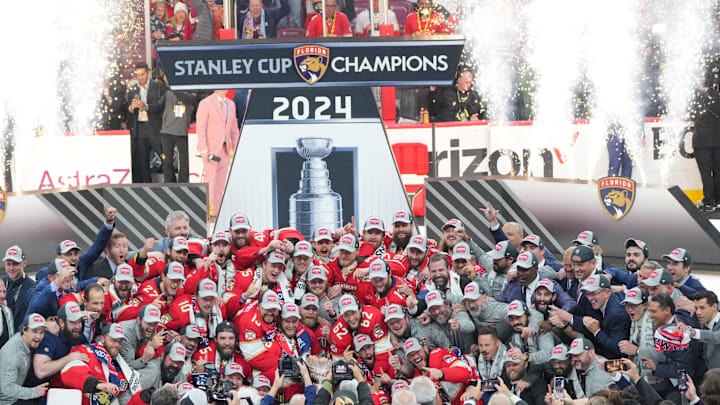
During his time with the Florida Panthers under Bill Zito, Mehta was part of an organizational structure that fully embraced a modern contender model, one that led to multiple Stanley Cup Final appearances and championships.
Florida’s success was not accidental. It was constructed through aggressive asset management, identity-driven roster building, and decisive high-impact trades.
The acquisition of Matthew Tkachuk exemplified a willingness to take calculated, franchise-altering risks. Players like Carter Verhaeghe were not just good stories. They were the result of targeted evaluation and opportunistic execution.
At some point, the New Jersey Devils will make their version of a Tkachuk-type move. Not necessarily the same player or position, but the same level of impact and intent. A bold, defining acquisition that signals a full commitment to contention and reshapes the identity of the roster.
This is what modern contention looks like. Analytics informing aggression, not replacing it.
A Necessary Evolution in New Jersey
The Devils now sit at a crossroads between two philosophies. One is the relationship-driven, culture-building model that defined Fitzgerald’s tenure. The other comes with a focus on leverage and an optimization-focused model that Mehta represents.
This is not a replacement. It is an evolution.
But the next phase demands something different. It requires fewer contractual constraints that limit roster movement. It requires a greater willingness to trade future assets for present impact. It requires a deliberate shift toward players who can thrive in playoff environments, those who forecheck, disrupt, and impose themselves physically.
In short, the Devils must become harder to play against without sacrificing their elite skill.
As this transition unfolds, the New Jersey Devils will also have to make difficult decisions not just on the ice, but within the organization itself. Philosophical alignment matters at this stage. Players, coaches, and even front office personnel who do not fully fit the direction being established by Sunny Mehta may eventually be moved or replaced.
This comes at a pivotal time in the hockey calendar, with the NHL Scouting Combine in Buffalo and the NHL Draft approaching, where foundational decisions are often made. This is a natural part of evolution for a team shifting from stability to contention, and for the Devils, alignment across all levels will become just as important as talent on the roster.
There is also an expectation that the Devils will look to move at least one significant contract this offseason. A player such as Dougie Hamilton represents the type of high cap hit that could be reallocated to better balance the roster and address more immediate needs.
Do not be surprised if a fan favorite is moved this offseason. The Devils have reached a point where difficult decisions are required to move forward. A player such as Hamilton may represent part of that shift, but he is unlikely to be the only one. Contending teams move valued players not out of failure, but out of necessity. If the Devils are serious about maximizing their window, sentiment cannot outweigh structure.
However, it would be surprising if Dawson Mercer were moved purely for financial flexibility. Mercer remains aligned with the team’s timeline and provides versatility that is difficult to replace internally.
More likely, any cap space created would be redirected toward acquiring a true finishing winger. The Devils need a player who can consistently convert chances and complement the pace and skill of Arseny Gritsyuk, bringing stability and production to the top six.
Not every solution will come from outside the organization.
The continued development of Lenni Hameenaho could quietly play a meaningful role in shaping the Devils’ forward group. Projected as a two-way threat on the wing, Hameenaho has the tools to contribute in all three zones while providing timely scoring.
His trajectory suggests a role similar to Tyler Toffoli. A reliable finisher who complements skilled centers without needing to drive play himself.
If Hameenaho reaches that level, the Devils may be able to solve part of their secondary scoring need internally, reducing pressure to overspend while still improving roster balance.
The Stakes of the Moment
The core is already in place. The window is not theoretical. It is open. The question is whether the organization will fully embrace the mindset required to capitalize on it.
Because in today’s NHL, contention is not achieved by simply assembling talent. It is achieved by relentlessly refining it.
If the Devils adopt the same principles that powered Florida’s rise, aggression, clarity of identity, and disciplined asset management, then this team has a legitimate path to a Stanley Cup.
If not, they risk remaining what they have intermittently been. A talented team capable of excitement, but not constructed for the demands of four playoff rounds.
The future of the Devils is not about choosing between Fitzgerald and Mehta.
It is about whether the organization can successfully transition from building a contender to operating like one. That distinction will define everything that comes next.
 Add us as a preferred source on Google