

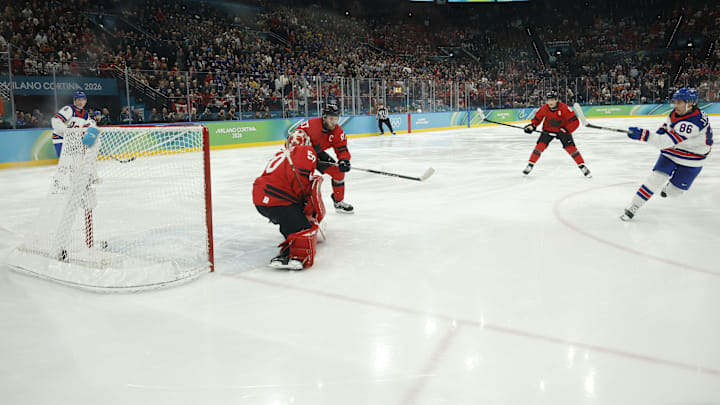
The United States men's and women's ice hockey teams won gold medals in the same Winter Olympics in the countries history, and both happened against Canada in overtime. The women's team defeated the Canadian women's team 2-1 last Thursday after overcoming a 1-0 on a tying goal from Hilary Knight in the final minutes of regulation, and an incredible goal by Megan Keller in overtime. Then, this past Sunday, the men's team ended a 46-year drought, defeating Canada 2-1 on an overtime goal from New Jersey Devils star Jack Hughes.
With both goals happening in overtime, they arrived on three vs. three hockey. In the NHL playoffs, there is continuous five-on-five hockey until someone scores a goal, but in this format it instead went to continuous three-on-three. This has led to debate as to whether or not this should be the format moving forward.
On Tuesday, the International Ice Hockey Federation (IIHF) president Luc Tardif told The Athletic that they were "pleased" with the overtime rules and has no intention to move on from the three-on-three format.
“It’s the best rules to fit in a tight schedule,” Tardif told The Athletic. “We have to figure out 30 games in 11 days for men and for the women 28 games in 13 days — 58 (games) — altogether in 16 days. Huge challenge.”
IIHF not moving on from three-on-three overtime format after 2026 Winter Olympics
While the United States celebrated their gold medals in the men's and women's tournaments, there was debate as to whether or not the format was the correct one.
During the round robin and preliminary stages, there was a five minute overtime period of three-on-three hockey. If no goal was scored, they would go to the shootout. In the qualification playoffs, quarterfinals, semifinals, and bronze medal games, the three-vs.-three overtime period would last for 10 minutes before going to a shootout. But in the gold medal game, it was continuous 20-minute overtime periods until a goal is scored.
This format was implemented back in 2019, as the IIHF sought and end to championship games being decided by shootouts. It also provided insurance for the IIHF that multiple hockey games would be played as scheduled instead of delayed due to multiple overtime periods.
Canada head coach Jon Cooper was critical of the format after the game, saying that it was "not hockey."
"You take four players off the ice, now hockey’s not hockey anymore. There’s a reason overtime and shootouts are in play — it’s all TV-driven to end games, so it’s not a long time. There’s a reason why it's not in the Stanley Cup final or playoffs," said Cooper, h/t Michael Traikos of The Hockey News.
Former Washington Capitals forward T.J. Oshie appeared on The Jim Rome Show and was critical of the overtime format, suggesting that it should follow the NHL's playoff overtime format of five-on-five hockey for continuous 20-minute periods.
"It should be just like the Stanley Cup Playoffs for a gold medal. I think it should be bronze medal as well. The games aren't played on the same day, so you have time for the rink. I understand there's tv stuff, but I think it should be five-on-five. That's how you should end the game," said Oshie. "I don't know if that would have made a difference, maybe the U.S. would have still won if it was five-on-five, we don't know that....You want to win as a team, you want to lose as a team. Three-on-three is different. It is not the same. If anything, I would say Canada has the edge on the three-on-three, so that probably should have benefitted them."
Despite the critique from those in the hockey world, the IIHF is holding firm in their stance. They believe it was a success and they are not moving on from it.
 Add us as a preferred source on Google