

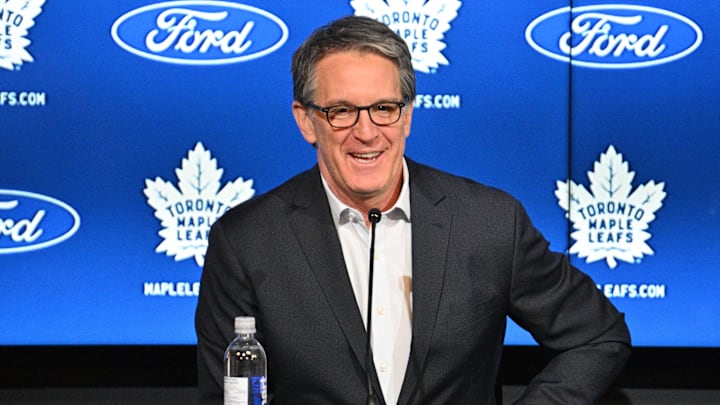
We've been discussing this for quite some time at Pucks and Pitchforks. The signs have been there. What once felt like subtle shifts within the New Jersey Devils organization has now become undeniable. The winds of change, much like a powerful gust rolling through the Ocean Grove and Asbury Park boardwalks, have arrived with force.
The decision, confirmed by managing partner David Blitzer, reflects both appreciation for the past and urgency for the future:
“Tom and I had a thoughtful conversation today and agreed it was time to move in a new direction. Tom changed the trajectory of our team here, including setting a franchise record for points in a season and helping make New Jersey a hockey destination. He is a well-respected leader across the Devils organization and NHL, and I am grateful for our friendship. I wish Tom and his family all the best. As we prepare to move forward, it is delivered in the way you expect and deserve, and I understand and share in your frustration. This is a critical offseason for our franchise, and we will explore all avenues that best position the Devils to compete for a Stanley Cup once again.”
That statement captures the reality of Fitzgerald’s tenure. He was instrumental in rebuilding the foundation of this team. He strengthened the prospect pool, made impactful acquisitions such as Jonas Siegenthaler and Timo Meier, and helped guide the organization through a difficult transition following Ray Shero’s departure after the Taylor Hall trade. That period ultimately produced meaningful assets like Kevin Bahl and Dawson Mercer, reinforcing that his work during the rebuild carried real value.
The high point came in 2023, when the Devils defeated the Rangers in seven games in the first round of the Stanley Cup Playoffs, signaling that the franchise had turned a corner. There was belief. There was momentum. And there was a sense that something sustainable was being built.
Recent drafts also showed improvement, with additions such as Mikhail Yegorov, Anton Silayev, Conrad Fondrk, Mason Moe, Trenten Bennett, and David Rozsival adding depth and potential to the system.
Progress stalled under Tom Fitzgerald
As expectations shifted from rebuilding to contending, the structure under Fitzgerald did not evolve with it. Holding both the President of Hockey Operations and GM roles concentrated too much authority without enough internal accountability. The roster, while talented, lacked the necessary flexibility to adapt. The contractual structure only compounded the issue, handcuffing the organization at a time when precision and decisiveness were required.
This is why the decision to move on was not only understandable, but necessary. The Devils are no longer chasing relevance. They are expected to win.
That distinction defines this offseason. The next general manager must bring a complete and modern approach, blending traditional evaluation with advanced analytics, while operating with a deep command of Collective Bargaining Agreement strategy. Just as critical is the ability to align scouting, development, and roster construction into a cohesive vision built for playoff success.
Would imagine Brendan Shanahan is going to get a hard look as Pres of Hockey Ops for the #NJDevils if ownership wants a POHO.
— Alex Chauvancy (@AlexC_NJD) April 6, 2026
Sunny Mehta, Jason Spezza and perhaps John Chayka as GM candidates, but there will be plenty more.
One name that stands out is Sunny Mehta. A former Devils analytics mind and a two-time Stanley Cup-winning assistant GM with the Florida Panthers, Mehta represents the type of executive who understands how to build a complete team. His track record reflects an ability to identify players who combine physicality, skill, and situational awareness, all while working within a structured and collaborative front office model.
At a higher level, the possibility of Brendan Shanahan as President of Hockey Operations introduces an entirely different dimension. The Devils have long been defined by identity, discipline, and accountability, and Shanahan embodies those traits. His history within the organization, alongside Martin Brodeur during the Lou Lamoriello era, connects directly to the standard that once made New Jersey a model franchise.
From a personal vantage point, attending the Devils game against Columbus offered a telling moment. Seeing David Blitzer seated near ice level, with Jake Reynolds nearby, and witnessing visible frustration as the Devils were shut out suggested that internal evaluation was already well underway. While not definitive, those moments often signal that decisions are forming behind the scenes.
This is where the Devils stand now.
The foundation exists. The talent is present. But the margin for error has disappeared.
This offseason is not about incremental improvement. It is about direction, structure, and identity. It is about determining whether this team becomes a legitimate Stanley Cup contender or remains a group that falls short of expectations.
Do not expect hesitation. Do not expect patience.
And do not be surprised if the next era of Devils hockey is defined by bold leadership, beginning with a new voice in the front office and possibly the return of Brendan Shanahan to set the standard once again.
 Add us as a preferred source on Google