

The New Jersey Devils are running out of time, and the calendar is no longer on their side. With the NHL Trade Freeze approaching and the Olympic break set to pause league play for weeks, the organization is entering a moment that will expose every flaw in its planning. This is the portion of the season where direction matters, and right now, the Devils lack it.
This is not simply about a rough stretch in the standings. It is about a front office that has repeatedly leaned on internal optimism while burning through valuable years of a talented core. Under Tom Fitzgerald, the margin for error has disappeared, yet the same structural issues remain. Questionable roster construction, fragile depth, and short-term gambles have left the Devils stuck between contention and regression.
What happens before the freeze, during the break, and into the offseason will determine whether this franchise finally resets or continues drifting toward another wasted era.
For those who are not up to speed, the NHL Trade Freeze is approaching rapidly, and the Olympic break is set to begin in mid-February. The break will span roughly two to three weeks, consisting of a 7–10 day group stage followed by a one-week knockout round for the medal games. This stretch of the calendar matters because it freezes leverage, slows momentum, and forces organizations to live with the consequences of decisions already made.
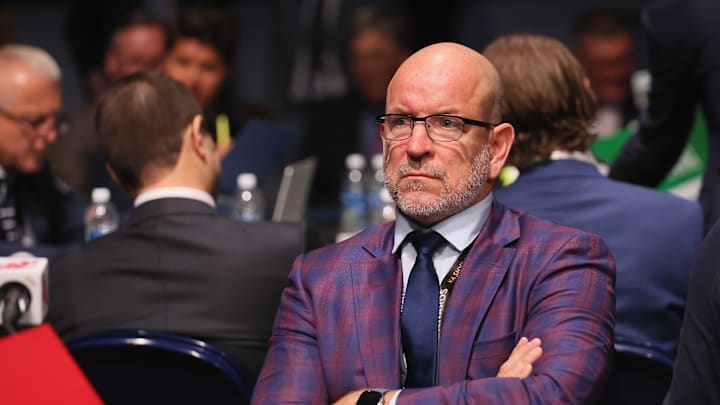
For the New Jersey Devils, this moment exposes a deeper truth: general manager Tom Fitzgerald has once again failed both the roster and the fanbase.
The Devils have not had a meaningful run since the 2023 Stanley Cup Playoffs. As things stand, it has been nearly three full years since this team last made the postseason. That alone would be concerning, but the larger issue is trajectory.
What makes this stretch especially dangerous is how it intersects with the long-term future of the core. Under Fitzgerald’s timeline, the risk of eventually losing a franchise center like Nico Hischier becomes more pronounced. When a team drifts without direction, extensions become harder to justify, especially for players who want to win. Every wasted season chips away at organizational credibility.
Roster construction is at the heart of the problem. The Devils are essentially built around Jack Hughes and Luke Hughes, both of whom are elite talents, but neither of whom should be carrying the entire structural weight of the franchise. When injuries inevitably occur, the lack of insulation becomes obvious. This is not a resilient roster. It is fragile, overly dependent on health luck and internal growth, and lacks adequate stabilization from veterans.
That fragility is magnified in goal. Jacob Markstrom is an aging goaltender who increasingly looks more like Mr. Hyde than Dr. Jekyll. Before the trade that sent a first-round pick and Kevin Bahl to Calgary, it was already a questionable move. The reasoning was straightforward: age matters, especially at the goaltending position.
Markstrom is extremely streaky. Yes, he can still be a gamer when he is locked in, but history tells us that goalies in their mid-to-late 30s tend to depreciate quickly. Like a high-performance sports car, once the wear begins, multiple components tend to fail at once.
That trade represented a misunderstanding of both timeline and probability. It gambled premium assets on short-term stability that was never guaranteed. The Devils would be better served pivoting now rather than doubling down.
It is time to give Nico Daws his opportunity. He deserves legitimate NHL starts instead of being buried in Utica. At a minimum, the organization owes itself clarity. If Daws can establish himself as a capable option, it changes the entire short-term outlook in net and allows the Devils to bridge toward their next wave without forcing rushed decisions.
At the same time, the Devils need to align their goaltending strategy with their pipeline. Jakub Malek continues his progression through the AHL, while Mikhail Yegorov develops at the NCAA level. Veeti Louhivaara is already showing signs of becoming a viable long-term backup or No. 2 option, posting a 4-2-3 record, a 2.83 goals-against average, a .913 save percentage, and a shutout in nine USHL games. This is not a barren system. It simply needs coherent planning.
Trenten Bennett further reinforces that point. Currently 19 years old, he is set to begin NCAA play at St. Lawrence University this autumn. Benefiting from the “Matthews Effect,” being born early in his birth year confers a developmental advantage that often accelerates adaptation relative to peers born later in the same class.
From a trade deadline perspective, the Devils must act. Evgenii Dadonov and Luke Glendening are veterans who should be moved before the 2026 NHL Trade Deadline. Glendening should return a seventh-round pick. Dadonov could fetch a fourth-rounder, with performance-based conditions that elevate the return to a conditional third. These are not franchise-altering moves, but they are necessary steps toward reclaiming flexibility.
The offseason, however, is where the real reset must occur. With RFAs like Simon Nemec and Arseny Gritsyuk needing new contracts, the situation cannot move forward as it has. Stagnation at the top eventually seeps into every layer of the organization.
Leadership must prioritize aggression with purpose. The Devils need players who shoot with volume, generate rebounds, and create chaos in the offensive zone. They need a coach who understands how to properly deploy young talent like Gritsyuk and Hameenaho, and ensure players like Dawson Mercer are not allowed to drift into stagnation.
The Devils do not lack talent. They lack direction, urgency, and accountability. The clock is ticking, and the margin for error is gone. Having little to no movement before and after moving on from Ondrej Palat is unacceptable, and handing out too many no-trade and move clauses is more pathetic and despicable, handcuffing this team, and now they need to retool.
 Add us as a preferred source on Google