

One of the most common post-trade deadline topics is buyouts. Just about every team in the NHL has a contract it would like to erase. If only there were a giant magic marker that could get rid of such contracts.
In a roundabout way, there is. The NHL salary cap rules allow for buyouts. However, buyouts don’t necessarily clear unwanted contracts off the board. They allow teams to get out from under burdensome deals, but do carry with them some additional baggage.
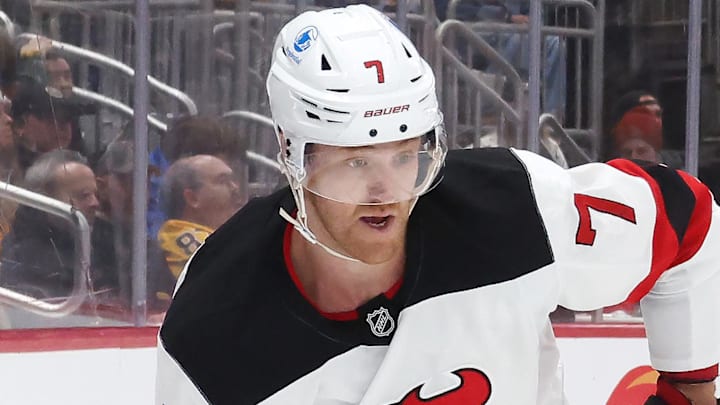
The New Jersey Devils are no different. The chatter regarding a potential Dougie Hamilton trade, one that has not materialized, has led fans and pundits to speculate the possibility of buying out the last two years of Hamilton’s seemingly onerous deal.
But when crunching the numbers, buying out Hamilton would be a terrible decision for the Devils.
Let’s start with the contract as is. Hamilton has two more years on his current deal, carrying a $9 million cap hit. That alone is the justification for wanting to move on from Hamilton. The Devils would like to retool, but the limited cap space gets in the way. And with so many young blueliners in the pipeline, Hamilton is a luxury the club just can’t afford.
Since trading him has been extremely complicated, a buyout could become an alternative. Off the bat, rules dictate that Hamilton’s two years would become four. In general, when a player’s contract is bought out, the remaining years are doubled.
Then, there’s the question of the cap hit itself. According to PuckPedia’s calculations, the first year would actually not yield any cap relief at all. The Devils would be on the hook for $9.04 million. The second year, the relief kicks in, providing about $4.3 million in relief.
That sounds okay, but the last two years of the buyout, the Devils would be on the hook for about $1 million. That’s TWO extra years of dead cap space.
As you can see, buying out Hamilton makes no sense. The Devils need cap space now, not in three years. In fact, Hamilton’s contract will be off the books by then anyway. So, buying out the right-shot defender really makes little sense.
Trading Hamilton even with retention is a much better deal
One of the things that the Devils have been rumored to dislike is the idea of trading Hamilton with retention involved. But just from the raw numbers, that would be a much better deal.
Let’s assume the Devils find a willing trade partner. That partner is willing to surrender two pieces, like a mid-round draft pick and a lower-tier prospect, in exchange for Hamilton and 50% off his contract.
Right there, the Devils would get an automatic savings of $4.5 million against the cap. Meanwhile, the club would only be on the hook for two more seasons as opposed to four via the buyout route. Moreover, the cap savings would be immediate. The Devils wouldn’t have to wait until the second year of the buyout to see the cap relief.
That’s why trading Hamilton, even at a seeming loss, would be a much better idea than attempting a buyout.
Could the Devils still opt for a buyout instead of a trade? It’s possible. It could be a last resort option if no other clubs stepped up with tangible offers. But then again, the club could take the entire offseason to figure something out. The next milestone to keep an eye on will be the 2026 NHL Draft. The Devils may find a trade partner by then. The rush would be to have cap space available for summer free agency. It will be interesting to see how the organization handles the situation moving forward.
 Add us as a preferred source on Google