

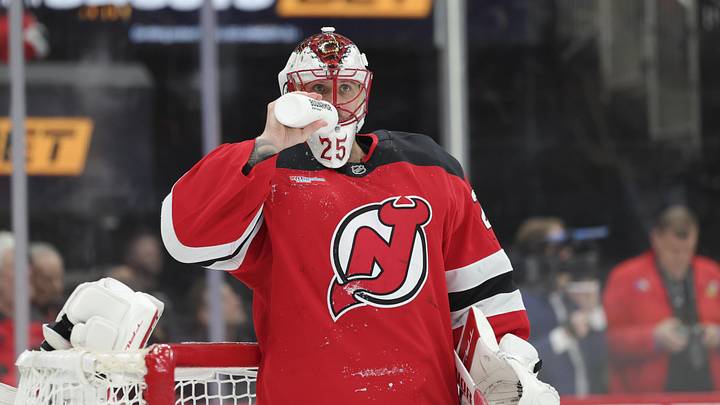
The current Stanley Cup Final can only be described as electric -- truly one of the best Cup Finals in recent memory already, despite having only gone on for four games so far. That said, if there is one singular piece of the puzzle that has been underwhelming, it is the goaltending on both sides of the ice.
For the Vegas Golden Knights, Carter Hart had a moderately strong first three rounds, with a goals saved above expected (GSAx) of +3.07. His series against the Avalanche in the Western Conference Finals buoyed this tremendously. Entering that series, he was sitting at a GSAx of -0.36. On the other side of the spectrum was Frederik Andersen, who was undeniably spectacular through the first three rounds of the playoffs, to the tune of a +12.48 GSAx (+12.99 of which came in the first two rounds).
In the Stanley Cup Final, though, the goaltending has been subpar. Hart has allowed 4.59 goals more than what was expected, and Andersen and Bussi have combined for a GSAx of -3.05.
The Stanley Cup Final shows the level of goaltending that can take a team to the Stanley Cup Final
Expanding the scope a bit past just beyond this season, this pattern continues. In 23 games last season, Sergei Bobrovsky sported a GSAx of +3.38 -- pretty bang-on average as far as playoff performances go. Stuart Skinner and Calvin Pickard combined for a -4.78 in 25 games. One season prior, Bobrovsky posted a -1.08 in the playoffs, and that same Edmonton tandem combined for a -0.75.
With all that in mind, perhaps goaltending isn't quite as important as once thought of in terms of building a championship-caliber team. Sure, it certainly can't hurt, as we saw through three series of Andersen dominating in net this playoff run, but it isn't the be-all-end-all that some seem to believe.
For the Devils, this is excellent news.
There's no doubt about it -- at best, the clearly frustrated Jacob Markstrom was average in 2025-26. Many would argue that he was well below-average; however, expanding the scope beyond conventional box score statistics and aggregating information paints the picture of a goalie who was a non-issue for most of the season.
On the year, Markstrom had a GSAx of -11.37, as per HockeyStats. That said, his two worst performances -- both clear outliers -- combined for -11.46 of that, giving him a GSAx of +0.09 over the course of the other 42 games he played. Those two games, an 8-4 loss in October to the Avalanche and a 9-0 drubbing against the Islanders, certainly clouded any idea that he was a typical goalie this past season. The reality is, though, he was a typical goalie, at least statistically speaking.
What this means for the Devils is that goaltending is -- or should be -- a non-issue in terms of both reaching the playoffs and succeeding there. Average goaltending should be, and has been in the past, perfectly fine enough to make real noise in the regular season and postseason. The bigger issue was always team-wide finishing in 2025-26, and as much as Markstrom has been the scapegoat for many of the team's issues, that reality is a bit far-fetched.
That is further exacerbated by Jake Allen being one of the league's premier backups. Realistically, excluding those outlier starts, the Devils had pretty good goaltending in the aggregate in 2025-26. If they fix the other issues they have, they should be fully capable of making a difference in the playoffs with the current tandem.
 Add us as a preferred source on Google